











































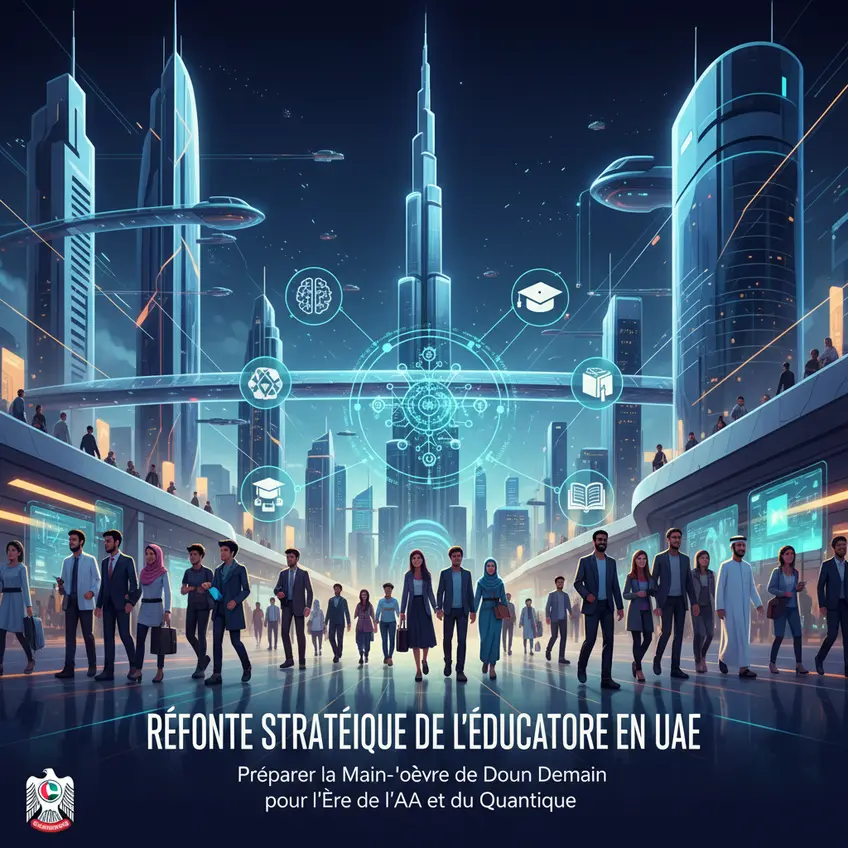
The UAE is resolutely positioning itself as a global hub of innovation, economy, and knowledge, embarking on a bold transformation of its higher education system. This strategic overhaul isn't just an adaptation, but a proactive anticipation of the deep shifts brought about by artificial intelligence (AI) and quantum computing. The goal is clear: to forge a highly skilled workforce, capable of navigating and thriving in a constantly evolving technological landscape, and to consolidate the UAE's vision for a diversified, knowledge-based economy. Preparing future leaders, engineers, researchers, and entrepreneurs is at the heart of this ambition, requiring a complete reassessment of curricula, teaching methods, and infrastructure. This approach guarantees not only the country's competitiveness on the international stage, but also the relevance and employability of its graduates in the digital age.
Foundations of Educational Transformation in the UAE: Vision and Strategic Imperatives
The transformation of higher education in the UAE rests on solid foundations, rooted in the national vision of leadership and innovation. Beyond simple adjustments, this is a systemic metamorphosis aimed at aligning academic programs with the future needs of the labor market, heavily shaped by rapid advances in AI, robotics, biotechnology, and quantum computing. The key principles of this overhaul include personalizing learning, integrating cutting-edge technology, and developing essential transversal skills such as critical thinking, complex problem-solving, creativity, and collaboration. Historically, education in the UAE has always emphasized excellence, but the current era demands unprecedented agility and adaptability. Institutions are encouraged to innovate in their approaches, adopt hybrid models combining online and in-person teaching, and forge strategic partnerships with industry and international research centers. This proactive approach is crucial for the UAE to continue attracting top talent, driving research and development, and producing a generation of professionals capable of tackling the complex challenges of a globalized, technologically advanced world. Massive investment in digital infrastructure, cutting-edge laboratories, and scholarship programs is testament to this unwavering commitment to educational excellence and building a resilient, innovative workforce.
Current Trends & Recent Statistics (2024/2025): Educational Innovation Momentum in the UAE
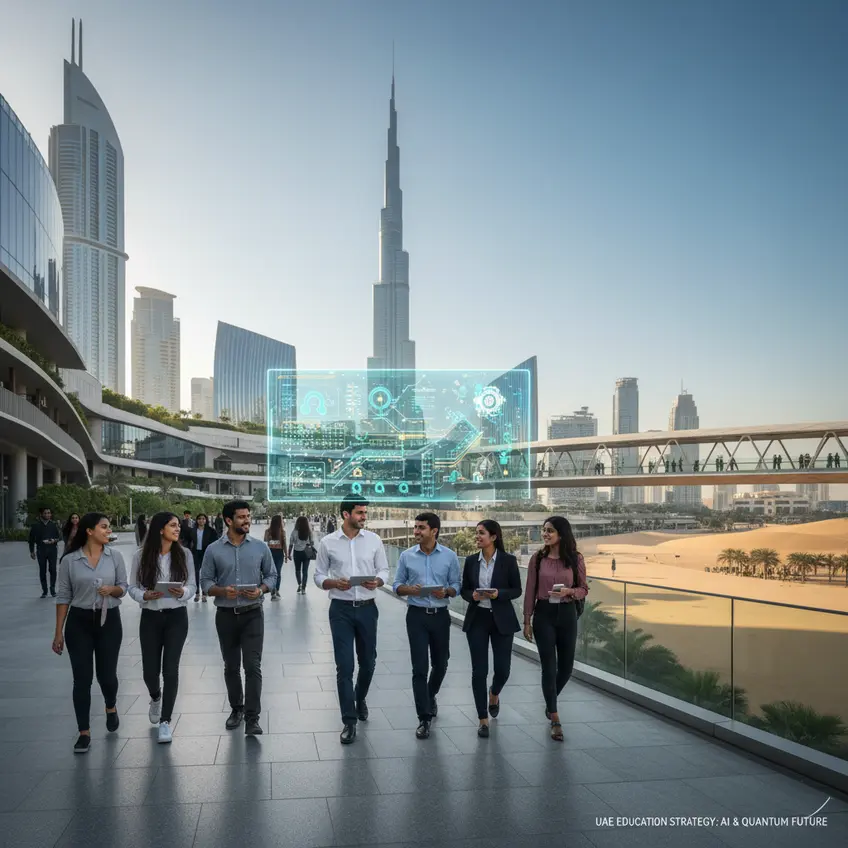
2024-2025 marks a period of acceleration for higher education trends in the UAE, with particular attention paid to integrating emerging technologies and personalizing the student experience. Universities in the UAE are investing massively in AI-based learning platforms, capable of adapting educational content to individual learning paces and styles. About 60% of university institutions in the UAE have already implemented or are testing adaptive learning systems, a significant increase from the 30% observed in 2022. This approach aims to optimize student engagement and improve success rates in complex technical fields. At the same time, there's a sharp rise in demand for specific skills in data science, cybersecurity, robotics, and, increasingly, quantum computing. Enrollment in AI- and data-analysis-related programs has grown 25% this year, underscoring the growing appeal of these future-facing careers. Furthermore, collaboration between academia and industry is at its peak, with more than 80% of universities in the UAE having active partnerships with tech companies, research centers, and startups, facilitating internships, applied research projects, and knowledge transfer. Continuing education and professional retraining, particularly for adults, are also fast-growing sectors, with short, certifying programs designed to meet the market's rapid needs.
The Rise of Virtual Campuses and Extended Reality
The integration of virtual reality (VR) and augmented reality (AR) into higher education in the UAE is transforming the learning experience. From immersive virtual labs to AR tours of historical sites, these technologies offer unique opportunities for exploration and experimentation. Complex simulations, particularly in engineering and medicine, are becoming more accessible and safer. Recent statistics show that more than 45% of universities in the UAE are actively exploring or have already deployed VR/AR-based learning modules to enrich their programs, creating a dynamic, stimulating educational environment. This lets students manipulate virtual objects, practice surgical procedures without risk, or design architectural structures in three-dimensional space, fostering deeper understanding and better retention of concepts.
The Rise of Cybersecurity and Quantum Computing
Faced with growing digitalization, cybersecurity has become an absolute priority for the UAE's infrastructure, and higher education reflects this urgency. Cybersecurity programs are being not just strengthened but made more accessible, with a 30% increase in students enrolling in these fields in 2024. At the same time, quantum computing, while still in its infancy, is identified as a strategic field. Several universities in the UAE have launched research initiatives and introductory courses on the principles of quantum mechanics and quantum algorithms, training the first cohorts of experts. These developments are essential to prepare the nation for the challenges and opportunities of the post-digital era. Investment in specialized labs and collaboration with global research institutes position the UAE as a key player in the development of these breakthrough technologies.
Comparing the Leading Pedagogical Approaches for the AI and Quantum Era
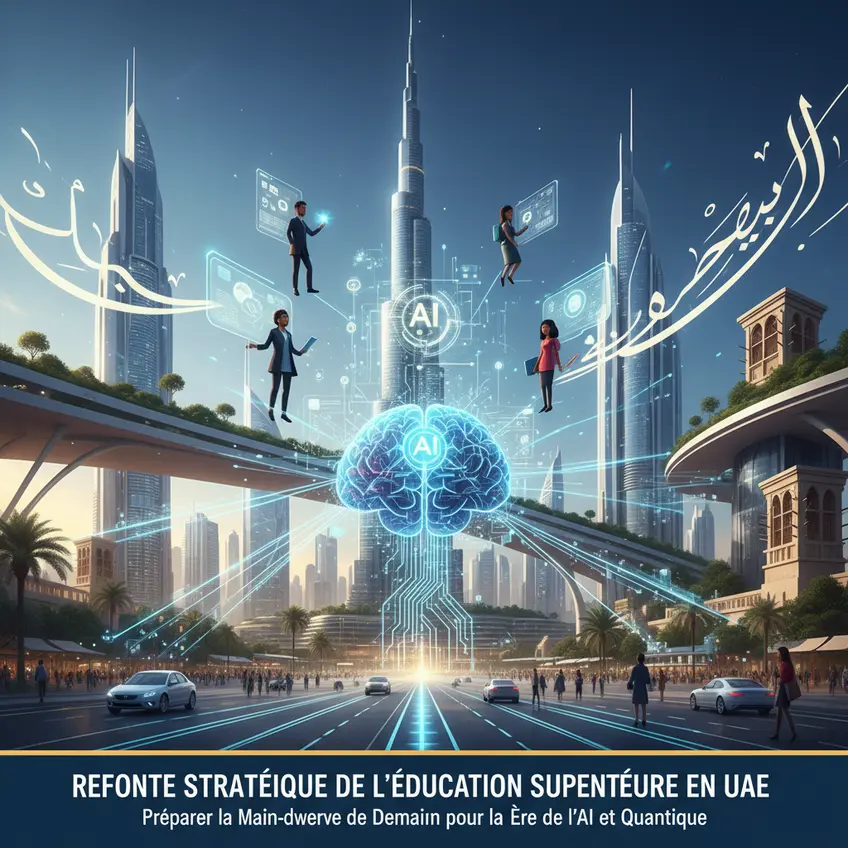
The transformation of higher education in the UAE for the AI and quantum era isn't limited to adding new courses, but encompasses a deep overhaul of pedagogical approaches. Various methodologies are being explored and compared to determine which are most effective in training a future-proof workforce. Each approach has its pros and cons, and the UAE's strategy often involves combining best practices to create a holistic, dynamic learning environment. The goal is to move beyond simply transmitting knowledge to developing critical, creative, and adaptive skills, essential for innovating in fast-evolving sectors. The focus is on project-based learning, real-world case studies, and immersive experiences, letting students confront theory with practice and develop a nuanced understanding of technological and societal issues. Interdisciplinary collaboration is also strongly encouraged, breaking down traditional silos between faculties to foster an integrated approach to complex challenges. Training teachers and professors in these new methods is a fundamental pillar of this transition, ensuring that faculty are equipped to guide students through these transformed learning paradigms.
Detailed Comparison Table: Key Pedagogical Models
This table highlights the characteristics of the major pedagogical models adopted or being considered at higher education institutions in the UAE to prepare students for the challenges of AI and quantum computing. It illustrates the diversity of strategies deployed to cultivate innovation and adaptability.
Practical Guide: Implementing a Future-Oriented Education Strategy in the UAE
Implementing a future-oriented education strategy, particularly for AI and quantum computing, requires a structured, pragmatic approach. This guide breaks the process down into key steps, offering actionable advice for institutions in the UAE looking to position themselves at the forefront of educational innovation.
Step 1: Assess and Strategically Repositioning Curricula
The first phase involves conducting a full audit of existing programs. It's crucial to identify gaps and opportunities for integrating modules focused on AI, machine learning, data science, and quantum computing principles. This process should involve industry experts to ensure alignment with in-demand market skills. The goal is to create interdisciplinary pathways, such as a website development in Dubai track with integrated AI modules, or specializations in quantum cybersecurity. Prerequisites and learning objectives need to be rethought to develop critical skills that go beyond pure memorization, favoring complex problem-solving and creative thinking.
Step 2: Invest in Technology and Pedagogical Skills
Educational innovation can't happen without substantial investment in technological infrastructure and faculty training. This includes acquiring supercomputers, AI-dedicated cloud platforms, quantum simulators, and advanced research labs. At the same time, it's essential to offer professional development programs for teachers, training them in new pedagogical methods (project-based learning, gamification) and the use of advanced digital tools. An institution might, for example, train its staff to use generative AI tools to create interactive educational content. Support for applied research is also crucial, encouraging professors to engage in projects that directly contribute to advances in AI and quantum computing.
Step 3: Forge Strategic Partnerships and Promote Research
To ground education in industrial and research reality, building strong partnerships is non-negotiable. Universities in the UAE should actively collaborate with tech companies, innovative startups, and local and international research centers. These alliances can take the form of paid internships, joint research projects, industry-funded university chairs, or mentorship programs. For example, a partnership with a mobile app development company would let students work on real cases of mobile app development in Dubai incorporating AI. Additionally, it's essential to create university incubators and accelerators to encourage entrepreneurship and support the creation of tech spin-offs from student and faculty research.
Common Mistakes and Myths to Debunk in the UAE's Educational Overhaul
The transition to higher education focused on AI and quantum computing is a path filled with pitfalls and misconceptions. In the UAE, as elsewhere, it's crucial to identify and debunk these mistakes and myths to ensure the reform's success. Ignoring these pitfalls can lead to inefficient investment, resistance to change, and, ultimately, an education system that fails to adequately prepare tomorrow's workforce.
Myth 1: AI Will Entirely Replace Teachers
This is a widespread but unfounded fear. AI is a powerful tool that can automate repetitive tasks (grading, basic tutoring), but it cannot replace the human role of inspiration, mentorship, and developing critical thinking and emotional intelligence. Teachers in the UAE should instead see AI as a collaborator, an assistant that frees up time for more meaningful interactions with students. AI enables unmatched personalization of learning, helping teachers better understand each student's individual needs and adapt their pedagogy accordingly, thereby reinforcing their central role.
Myth 2: Only STEM Fields Are Affected by AI and Quantum Computing
While STEM fields are at the heart of these technologies, the impact of AI and quantum computing is cross-cutting. The humanities, arts, law, economics, and management will also be deeply transformed. It's essential to integrate modules on AI ethics, digital law, and the societal impact of quantum technologies into every curriculum. Marketing graduates will need to understand how AI optimizes campaigns and data analysis, while healthcare professionals will need to master AI-assisted diagnostic tools. In the UAE, the vision is to equip all students with solid digital literacy, regardless of their specialty.
Myth 3: Adding a Few Courses Is Enough to Be "AI-Ready"
Integrating a few courses on AI or quantum computing is a good start, but it's not enough. A true overhaul requires systemic transformation: revising teaching methods, ongoing teacher training, creating interdisciplinary labs, and developing transversal skills. It's about changing the educational culture to encourage experimentation, collaboration, and lifelong learning. In the UAE, this means adopting a holistic approach where every discipline integrates the principles of these new technologies, encouraging critical thinking and innovation at every level.
Best Practices and Advanced Strategies for Educational Excellence in the UAE
For the overhaul of higher education in the UAE to bear fruit and effectively prepare the workforce for the AI and quantum era, it's essential to adopt advanced strategies and draw on international best practices. These approaches go beyond superficial adjustments and aim for deep cultural transformation within academic institutions.
Develop Interdisciplinary, Flexible Programs
The challenges of AI and quantum computing aren't confined to a single discipline. The UAE must foster the creation of programs that cross STEM with the humanities, ethics, law, and economics. Dual degrees, specialized minors, and interdisciplinary certificates will let students gain a holistic understanding of technological implications. Curriculum flexibility is also essential, letting students personalize their path based on their interests and the rapid evolution of the labor market, incorporating, for example, modules from a website development in Dubai track or big-data management.
Bet on Active Pedagogy and Experiential Learning
Lecture-based teaching must give way to more interactive, experiential methods. Group projects, real-world case studies, hackathons, simulations, and internships are powerful vectors for developing practical skills. Universities in the UAE should establish innovation labs where students can experiment with cutting-edge technology, work on concrete industrial challenges, and develop innovative solutions. An example would be creating a center where computer science and design students collaborate on website creation in Dubai incorporating AI features.
Strengthen Ties With Industry and Global Research
The relevance of educational programs is directly tied to their alignment with industry needs. The UAE must intensify collaboration with tech companies, research centers, and startups. This includes co-designing programs, hosting professionals as speakers or mentors, and establishing technology transfer platforms. Active participation in international research networks and attracting world-renowned researchers are also crucial for driving innovation and positioning the UAE as a center of excellence in AI and quantum computing. A digital marketing consultant in Dubai could, for example, speak regularly to business students.
Promote the Development of Soft Skills
In a world dominated by technology, human skills such as creativity, critical thinking, communication, collaboration, and adaptability become even more valuable. Educational programs in the UAE must explicitly integrate the development of these "soft skills" through team projects, presentations, debates, and specific training. The ability to express oneself clearly, work in a multicultural team, and solve complex problems are major assets for any career in the AI era, where humans and machines collaborate. Personal branding in Dubai & UAE is also an essential skill for standing out.
Case Studies and Concrete Examples: Success and Innovation in the UAE
The overhaul of higher education in the UAE isn't just a theoretical vision; it's already materializing through concrete initiatives and inspiring successes. Several institutions and projects demonstrate the country's commitment to preparing its youth for the challenges of the digital age.
Mohamed bin Zayed University of Artificial Intelligence (MBZUAI)
MBZUAI, the world's first university dedicated exclusively to artificial intelligence, is an emblematic example of the UAE's ambition. Founded in 2019, it offers master's and doctoral programs entirely specialized in computer vision, machine learning, and natural language processing. Its model rests on intensive research, attracting global talent, and close collaboration with local and international industries. MBZUAI has already produced pioneering research and trained cohorts of highly qualified graduates who contribute directly to the UAE's innovation ecosystem. It's a beacon for the UAE in the field of AI, demonstrating the feasibility and success of a hyper-specialized approach.
American University of Sharjah (AUS) Programs in Engineering and Computer Science
AUS, recognized for its academic excellence, has considerably strengthened its offerings in engineering and computer science to incorporate the latest advances. It offers specializations in data science, cybersecurity, and robotics, and has recently launched research projects on applying AI in smart cities across the UAE. AUS works closely with local companies to offer internships and capstone projects that address real industrial needs, ensuring its graduates are immediately operational and relevant to the labor market. The dynamism of its computer science department reflects growing demand for skills in software development and project management, a field where a web agency in Dubai would find highly sought-after profiles.
Skills Development Initiatives by the Dubai Future Foundation (DFF)
The DFF, through initiatives like "One Million Arab Coders" or specialized workshops, plays a crucial role in developing digital skills for all ages. While not directly a higher education institution, its work complements and influences university programs by identifying key skills and offering targeted training. These programs prepare students and professionals for the rapid evolution of the technological world, giving them a competitive edge. The DFF also promotes tech entrepreneurship, encouraging young people to create their own startups and contribute to the UAE's digital economy, with support from a website creation agency in Dubai & UAE to get their projects online.
Technology Innovation Institute (TII) Quantum Computing Research Center
TII, based in Abu Dhabi, has established one of the first research centers dedicated to quantum computing in the MENA region. This center is not only a cutting-edge research hub, but also an essential partner for universities in the UAE looking to integrate quantum computing into their programs. Collaborations are in place to offer research opportunities to graduate students, specialized seminars, and access to cutting-edge quantum computing infrastructure. This initiative positions the UAE at the forefront of global quantum research, attracting brilliant researchers and students eager to work on the technologies of the future.
Shaping the Future: UAE Higher Education Toward 2035 and Beyond
The UAE isn't content to merely react to current trends; the country is actively anticipating the future of higher education, looking well beyond 2025 to shape a workforce ready for the decades to come. This forward-looking vision includes bold innovation, agile regulatory frameworks, and even deeper integration of technology in service of learning.
Hyper-Personalization of Learning: The Role of AI Teaching Assistants
By 2035, learning in the UAE will be characterized by extreme hyper-personalization. AI-based teaching assistants, far more sophisticated than today's tools, will understand each student's learning style, strengths, and weaknesses in real time. They will be able to generate dynamic learning paths, suggest relevant resources, and even simulate adaptive VR/AR learning environments for immersive experiences. These systems will not only help students master complex concepts related to AI and quantum computing, but also develop essential transversal skills, such as critical thinking and creativity, by offering them challenges tailored to their level and interests. Interaction with these AIs will be as smooth and natural as a human conversation, radically transforming the university experience and making it more engaging and effective. Imagine a student working on a website in Dubai project and receiving real-time advice from a UX/UI expert AI.
Metaverse Campuses and Immersive Educational Experiences
Physical campuses will coexist with fully virtual, immersive campuses in the metaverse. Students in the UAE will be able to attend classes, collaborate on projects, take part in international conferences, and even interact with professors and peers as avatars, regardless of their geographic location. These environments will offer virtual quantum labs where users can manipulate qubits, business simulations for tackling AI-based challenges, or interactive historical reconstructions. Education will become a global, accessible, borderless experience, fostering unprecedented international collaboration and a deep understanding of diverse cultures and perspectives. A web agency in Dubai & UAE could even set up virtual offices there for internships.
Micro-Credentials and Continuous Lifelong Learning
The concept of a single degree will lose weight in favor of a portfolio of micro-credentials and digital badges, attesting to specific, regularly updated skills. Learning will no longer be confined to the early years of life, but will become a continuous, dynamic process, powered by lifelong learning platforms. Workers in the UAE will be able to acquire new skills in AI, digital ethics, or quantum programming at any point in their career, ensuring their employability and adaptability to the market's changing demands. Universities will transform into lifelong learning resource centers, offering flexible, modular pathways, co-designed with industry for maximum relevance.
AI Ethics and Quantum Governance at the Heart of Curricula
As AI and quantum computing continue to advance, ethical, legal, and societal questions will become central. Future professionals in the UAE will be trained not only in the technical aspects, but also in the responsible governance of these technologies. Mandatory courses on AI ethics, data privacy, the socio-economic implications of automation, and quantum regulatory frameworks will be integrated into every curriculum. The goal is to train informed citizens and leaders, capable of making responsible decisions and building a technological future that serves the common good. The ability to engage with ethics experts and lawmakers will be as important as mastering algorithms.
Frequently Asked Questions (FAQ) on the Transformation of Education in the UAE
The strategic overhaul of higher education in the UAE raises many questions. Here are the answers to the most frequently asked questions, to inform students, parents, educators, and professionals.
What is the main goal of the educational overhaul in the UAE?
The main goal is to prepare the UAE's workforce for the challenges and opportunities of the AI and quantum computing era, by training individuals with advanced technical skills and strong adaptability and innovation capabilities for a knowledge-based economy.
How is AI integrated into university programs?
AI is integrated in multiple ways: the introduction of specialized courses in machine learning and data science, the use of adaptive learning platforms, and the integration of AI ethics modules across various disciplines. Students work on real projects and use AI tools to optimize their learning.
What new skills will be most sought after by employers in the UAE?
Beyond technical skills in AI and quantum computing, employers in the UAE will look for skills in complex problem-solving, critical thinking, creativity, interdisciplinary collaboration, adaptability, and a solid understanding of technological ethics. Profiles like a digital marketing consultant in Dubai with AI skills will be highly sought after.
Are traditional fields of study still relevant?
Yes, traditional fields remain relevant but are enriched by the integration of emerging technologies. A business degree, for example, will include modules on AI-driven data analysis or digital marketing, ensuring graduates' relevance and employability across every sector in the UAE.
How do universities in the UAE encourage innovation and research?
Universities encourage innovation by creating cutting-edge research labs, funding innovative projects, collaborating with industry, and offering scholarship programs for doctoral research. They also organize conferences and hackathons to spark creativity. Supporting student entrepreneurship is also key.
What are the major challenges of this educational transformation?
Challenges include the need for ongoing teacher training, significant investment in technological infrastructure, rapidly adapting curricula to technological changes, and raising community awareness of the importance of lifelong learning. Ensuring equitable access to new technology is also a significant issue.
Practical Checklist: Successfully Preparing for the AI and Quantum Era in the UAE
To successfully navigate the changing educational and professional landscape in the UAE, this checklist will guide you through the key steps to optimize your path and skills for the challenges of AI and quantum computing.
- Assess degree programs: Actively research universities and programs in the UAE that integrate AI, data science, cybersecurity, or quantum computing fundamentals into their curricula.
- Develop technical and soft skills: Beyond coursework, engage in personal projects, bootcamps, and extracurricular activities to strengthen your technical skills and soft skills (collaboration, communication, problem-solving).
- Leverage online resources: Use MOOC platforms, tutorials, and online certifications to deepen your knowledge of AI, machine learning, and quantum programming.
- Seek internships and hands-on experience: Company internships, research projects, or volunteering at tech startups in the UAE are essential for gaining concrete experience and building your professional network.
- Build a professional network: Attend conferences, workshops, and networking events in the fields of AI and quantum computing. A good network can open doors to unique career opportunities.
- Adopt a continuous learning mindset: The world of AI and quantum computing evolves quickly. Commit to ongoing training, stay curious, and keep up with the latest innovations to maintain your relevance in the UAE's labor market.


