





















































The United Arab Emirates' ambition to become a global leader in Artificial Intelligence is crystallized by the UAE AI Strategy 2031. Cities like Dubai and Abu Dhabi are not just adopting AI; they are integrating it into the core of their public services—from security and healthcare to justice and municipal services. However, this radical digital transformation raises fundamental questions of ethics, transparency, and governance.
For technology companies, consulting firms, and especially web agencies in Dubai and across the Emirates, mere technical knowledge of AI models is no longer sufficient. It is imperative to understand and integrate Emirati regulatory frameworks (such as the PDPL) to ensure compliance, algorithmic fairness, and citizen trust. Service offerings, including website design in Dubai and mobile application development, must now align with "Trust by Design" principles.
This comprehensive guide analyzes the regulatory landscape, the ethical challenges specific to the UAE, and the strategic roadmap for players seeking to establish themselves as trusted partners in the development of Ethical AI in the Emirates.
Foundations: The UAE Vision and Ethical AI Principles
AI governance in the UAE is based on a proactive approach that seeks to maximize the benefits of AI while mitigating social and ethical risks.

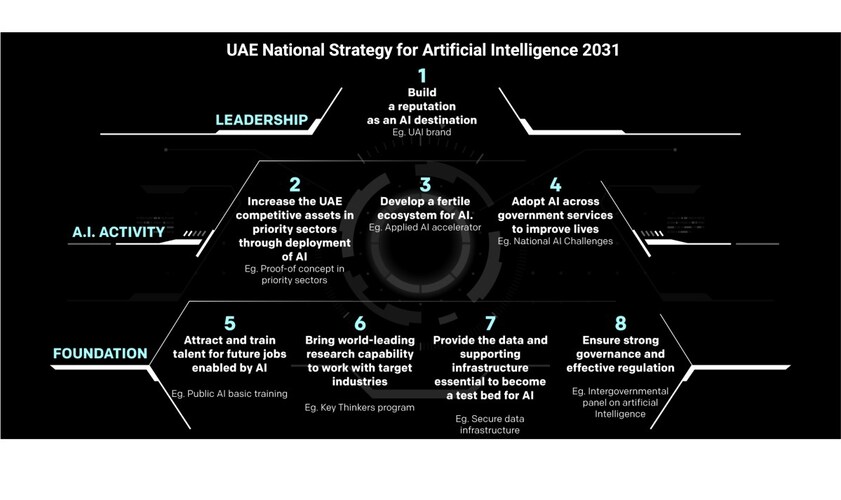
The AI Strategy 2031 and the Governance Model
The AI Strategy 2031 aims to position the UAE as the top country globally in AI investment and application. To achieve this, authorities have established an AI Governance Framework to regulate its use in key sectors.
This framework is generally structured around:
- High-Level Ethical Guidelines: Defined by federal and local entities (e.g., Dubai Future Foundation, Smart Dubai/Digital Dubai).
- Sector-Specific Regulations: Rules specific to health (medical data processing), finance, or security.
- Data Legislation: The PDPL (Personal Data Protection Law) is the cornerstone that governs the collection and use of personal data, which is crucial for training AI models.
For a web development agency in Dubai, this means every AI project for the public sector must start with a compliance analysis, not coding.
The Three Pillars of Ethical AI
Ethical AI, particularly in a public service context, rests on an essential three-part foundation. This is the basis for public trust and the legitimacy of decisions made by automated systems.
The Emirati Regulatory Landscape: PDPL and Key Authorities
The regulatory environment in the UAE is dynamic and imposes strict requirements that often exceed international frameworks.
The PDPL (Personal Data Protection Law)
The PDPL (Federal Decree-Law No. 45 of 2021) is the primary framework governing data protection in the UAE. Its impact on AI is significant.
- Consent and Purpose: The PDPL requires clear, specific, and informed consent for data collection and processing. AI models must be trained with data whose purpose of use aligns with the initial consent.
- Right to Withdrawal: Individuals have the right to withdraw their consent and request the deletion of their data. AI systems must be designed to allow for algorithmic "forgetting."
- Automated Decisions: The PDPL strictly regulates decisions made solely based on automated processing, guaranteeing citizens a right to human intervention and challenge.
For a web development agency in Dubai developing a government platform, PDPL compliance must be the bedrock of the backend architecture, not an added feature.
Local and Sectoral Regulations
Dubai and Abu Dhabi, as leading authorities, have specific frameworks:
The Technical Challenge: Bias, Explainability (XAI), and Robustness
The implementation of ethical and regulatory principles necessarily requires advanced technical solutions. This is where the expertise of a specialized web development agency becomes crucial.
Mitigating Algorithmic Bias
Bias is the most frequently cited risk in AI. It can be unintentional (historical data bias) or malicious.
- Representation Bias: If a facial recognition dataset for Dubai police services contains only a small minority of certain groups, the AI will be less accurate for those groups, leading to unfairness.
- Fairness Measures: Developers must use fairness metrics (e.g., Equal Opportunity Difference or Demographic Parity) to test and adjust models before production deployment.
- Continuous Auditing: Deployed platforms must include continuous auditing tools (performance monitoring) to detect model drift and new biases that might emerge over time.
AI Explainability (XAI)
In UAE public services, the opacity of "black boxes" is unacceptable. AI Explainability (XAI) is a regulatory and ethical imperative.
The goal of XAI is to allow the user (the official, the citizen, or the auditor) to understand why the AI made a certain decision.
Transparency and Immutability via Blockchain
To ensure the integrity of training data and the traceability of decisions, Blockchain technology is an essential governance tool in the UAE.
-
Blockchain Transparency: Using blockchain to record the hash (digital fingerprint) of training datasets. This proves that the model was trained with a specific dataset and was not altered later.
-
Immutable Audit Logs: Every critical decision made by the AI (e.g., sentence recommendation, citizenship application evaluation) is recorded as a transaction on a private blockchain, ensuring it cannot be modified retroactively.
Digital Strategy: The Role of the Web and Mobile Agency in Compliance
For web and mobile development agencies in the UAE, AI projects in the public sector are not typical development projects; they are governance and security projects.
The "Trust by Design" Approach
This methodology is inspired by Privacy by Design and extends it to AI ethical principles.
- Design Phase (Wireframing/UX): Integrate XAI features into website design in Dubai and mobile applications, making AI explanations accessible and not hidden in a secondary menu.
- Architecture Phase (Backend): Clearly separate raw data, training data, and operational data. Use Emirati cloud services for data localization (a key PDPL requirement).
- Testing Phase (QA): Add a mandatory step for ethical testing (Ethical Hacking & Bias Testing) before deployment.
Mobile Application Development in Dubai for Citizen Accountability
Government mobile applications are the most frequent point of interaction with citizens. They must be the place where ethics come to life.
- Consent Dashboard: The mobile application must allow citizens to granularly manage their consent to the use of their data by different AIs.
- Challenge Channel: Integrate a button or a chatbot (e.g., based on ethical conversational AI) allowing for quick challenging of an automated decision and request for human review.
- Source Transparency: Clearly indicate on the application the source of data used for the decision (e.g., "Decision based on registration data from RTA and DLD").
The Value Proposition of Marketing Consultants in Dubai
In this ultra-regulated market, marketing consultants in Dubai must sell Security and Compliance before the mere Speed or Novelty of the AI.
- Certification and Auditing: Position the agency as a certified or audited developer for PDPL/UAE AI Governance compliance.
- Trustworthy Content: The agency's own website (via a strong E-E-A-T strategy) must publish detailed case studies on bias mitigation and XAI deployment, proving its ethical expertise.
Sectoral Applications: Ethical AI in Action
The impact of ethical AI varies across the public sector. The challenges in justice are very different from those in infrastructure management.

Justice and Police: The High Risk of Bias
AI used in justice or policing (e.g., crime prediction, recidivism risk analysis, evidence sorting) is considered high ethical risk.
- Ethical Framework: Requirement for systematic human intervention (Human in the Loop) before the application of any critical AI-based decision.
- Explainability: The system must be able to explain to a judge or lawyer why an AI recommended a certain sentence or level of surveillance. Opacity is unacceptable in this domain.
- Data Security: Use of Federated Learning techniques to train models on sensitive data without ever moving it out of their secure silos (e.g., not consolidating police records and medical records).
Health and Social Services
AI in healthcare (diagnosis, resource allocation) has high benefits, but the processing of medical data is ultra-sensitive.
- Anonymization vs. Pseudonymization: AI models should preferably be trained on pseudonymized data (identifiers replaced by codes) rather than anonymized data, to maintain the traceability needed for clinical needs or auditing.
- Right to Challenge Diagnosis: The citizen must have an explicit right to request a second human opinion if a diagnosis or treatment recommendation is generated by the AI.
Municipal Services and Infrastructure (Moderate Risk)
In managing traffic (RTA), energy (DEWA), or urban planning (DLD), ethical risks are lower, but transparency remains essential.
- Service Transparency: AIs optimizing traffic lights must not systematically favor certain neighborhoods over others. Fairness metrics must be applied even to non-critical systems.
- Simplicity of Explainability: The explanation can be simplified: "Your waiting time increased by 10% due to an unexpected traffic surge in the DXB sector, detected by the RTA AI."
Next Steps: UAE AI Beyond 2025
The evolution of the ethical framework in the UAE is constant and is moving towards future technologies and global challenges.
Convergence with the Metaverse and Digital Identity
Dubai is investing heavily in the Metaverse. AI will be essential for populating these virtual worlds and providing government services in the 3D space.
- Avatar Ethics: AI managing government avatars (e.g., a municipal advisor chatbot in the Metaverse) must be clearly identifiable as non-human to prevent manipulation or deception.
- Identity Interoperability: AI systems must guarantee the integrity of the citizen's unique digital identity (via UAE Pass) when interacting with AI-based services in the real or virtual world.
Quantum-Resistant Cybersecurity
As the UAE develops quantum computing capabilities, the threat of data decryption by quantum computers becomes real.
- Role of Web Agencies in Dubai: The development of future government platforms and AI systems must include the adoption of Post-Quantum Cryptography (PQC) protocols to ensure the long-term security of health, security, and citizen data.
Automated Ethical Auditing
The UAE will move towards requiring automated ethical auditing tools.
- The Concept: Instead of occasional manual audits, the AI itself will be monitored 24/7 by a surveillance AI system (Auditing AI), which will alert authorities in case of performance drift, newly detected biases, or violations of fairness principles.
Conclusion and Strategic FAQ
The ethical and regulatory integration of AI into UAE public services is not a hurdle but a competitive advantage. By positioning itself as a global leader in responsible AI, Dubai and Abu Dhabi attract talent and investment focused on trust.
Summary of Key Requirements
Strategic Frequently Asked Questions (FAQ) for Technology Partners
Q1: How can a web agency in Dubai ensure an AI's compliance with the PDPL?
A: The agency must first identify the sensitive personal data used by the model. Then, it must ensure that consent collection mechanisms are explicit and granular. Finally, it must guarantee data hosting on UAE-localized servers and design APIs for the "right to be forgotten" function (deletion of training data) required by the PDPL.
Q2: What is Fairness by Design in an Emirati context?
A: It is an approach of integrating fairness from the beginning of the development process. For a web development agency in Dubai, this means: before training, audit the dataset for demographic imbalances; during training, use algorithms that minimize performance disparity between different population groups; and after deployment, monitor fairness metrics in real-time.
Q3: What is the impact of UAE Ethical AI on the cost of a development project?
A: Integrating ethics and compliance (XAI, bias mitigation, PDPL) increases the initial project cost. However, it significantly reduces the risk of litigation, harm to the public entity's reputation, and regulatory fines. Marketing consultants in Dubai must sell this as an investment in Operational Resilience and Citizen Trust.
Q4: Is Blockchain Transparency truly mandatory for AI systems in the UAE?
A: It is not always legally mandatory, but it is highly recommended in high-risk AI governance. Dubai is a global leader in blockchain adoption. Using blockchain to certify the integrity of datasets and decision audit logs is the most robust method for proving transparency and non-alteration, which is highly valued by government auditors.
Q5: How can web agencies in Dubai position themselves as experts in Public Service AI Regulation?
A: They must transform their website into a thought leadership platform. Publish detailed articles and case studies on XAI compliance, PDPL best practices, and algorithmic risk management. Obtain recognized security and compliance certifications. The message must be: "We don't just code AI; we make it trustworthy."


